
More parking, fewer bike lanes: City of Boston, T release new Blue Hill Avenue Redesign

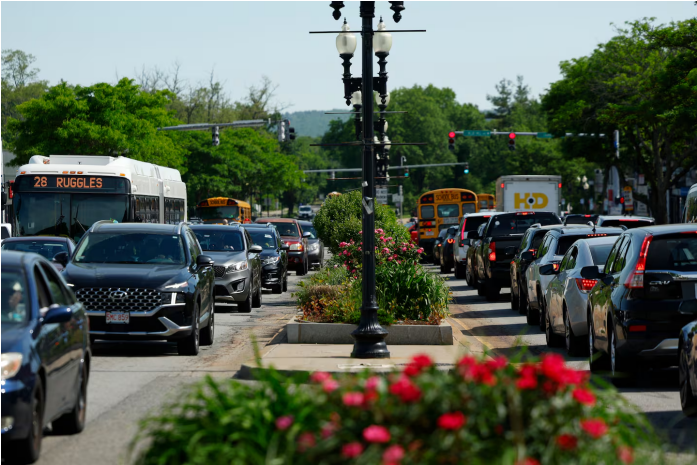
For years, residents and politicians have railed against the plan to reconfigure Blue Hill
Avenue and the impact that proposed bus and bike lanes could unleash on the busy
corridor through the heart of Black Boston.
Now city officials and the MBTA say they’ve funneled those concerns into a new design
that preserves a controversial center-running bus lane but significantly expands the
portions of the boulevard with two traffic lanes on each side.
The new plan shrinks the amount of proposed bike lanes to dedicate more of the road to
motor vehicle travel and parking between Grove Hall and Mattapan Square, effectively
creating a more car-friendly design.


Mayor Michelle Wu billed the plan as a “generationally transformational” layout, with $163 million in improvements to public transit and other public works that she said the
“worn and dated” thoroughfare desperately needs.
What it offers, Wu said, is “basically a full reconstruction that represents the biggest
investment in this transportation corridor in decades.”
The redesign also includes what officials called beautification improvements all along
Blue Hill Avenue, including newly repaved sidewalks, better street lighting, and 200
trees.
City officials and the T will host four public meetings on this proposal, starting Thursday
through Sept. 30. They’re aiming to finalize the design by the end of 2027. Phased
construction would begin the next year and last through 2030.
The layout marks the latest move to get the project underway since Boston launched the
redesign seven years ago, and there’s $95 million in federal funding on the line if it
doesn’t move forward. The state, the city, and the T are committing another $64 million
altogether.
In other parts of Boston, the Wu administration has faced scrutiny for stalling bike and
street safety improvement projects for years, before promising in July a slew of changes— including more concrete barriers on bike lanes— in the wake of the death of Boston
city planner and cyclist Louisa Gag.
But the fine-tuning on bike lanes for Blue Hill Avenue does little to change the
conversation around the issue that has generated the most pushback: the center-running
bus lane.
And it comes as critics have complained about how City Hall treats their input on
neighborhood projects, as well a longstanding frustration about decades of neglect on the
avenue dating to the 1950s, when the streetcar trolley along it was eliminated.
Another similar rapid bus transit project through Blue Hill Avenue died in 2009.
Earlier this year, Boston City Councilors Brian Worrell and Miniard Culpepper even
recommended replacing the center-running bus lane with an extension of the
Orange Line. The T vowed to study the option but suggested refocusing on “immediate
improvements.”
Some of those are laid out in the newest design.
Roughly 11 of the 14 existing miles of roadway in either direction would be preserved for
motor vehicles with two or more general-purpose traffic lanes. That’s far more than a
previous design in which 60 percent of the road would have had two lanes in either
direction.


Five blocks along Blue Hill Avenue would also be subject to rush-hour changes, in which
parking lanes would transform into travel lanes during peak traffic times.
There are other special carveouts: The design proposes creating a separated
“carriageway” near Franklin Park to make boarding buses easier, while a section in Grove
Hall would have a designated zone for safe school pickup and drop-off.
The new layout would increase the number of parking spaces to 717 from 675. Notably,
the plan would cut the number of all-day parking spaces by 10, but offset those losses with 52 spots available outside of traffic-heavy windows.
Near the Morningstar Baptist Church, for example, cars would be allowed to park on the
median on Sundays.
The bike lanes previously proposed in both directions along Blue Hill Avenue and
through Mattapan Square are gone in the new plan. Instead, officials suggested creating a
two-way separated bike path on the avenue along Franklin Park, and another from
American Legion Highway to Woodhaven Street.
And the proposed improvements extend well beyond the roadway itself. The design
includes plans for six miles of rebuilt sidewalks with accessible curb ramps and 19 new
walk signals.
Altogether, the addition of the center-running bus lane and bus boarding platforms is
expected to reduce travel times for 40,000 daily bus riders by 10 to 15 minutes. Car
traffic would be faster in the proposed layout than the previous design, officials estimate.
State Representative Russell Holmes, whose district covers much of the corridor, said the
design is proof officials have “changed everywhere that we can” in response to
community feedback.
“Everybody has their desires, and no one gets everything they want,” the Mattapan
Democrat said. “But this is about balancing bikes, bus riders, cars, walkers, and students.
It’s about everybody.”
But not everyone is satisfied with the latest layout.
Dianne Wilkerson, a former Massachusetts state senator and critic of the project, said the
new design does not address her and other community members’ primary concern about
the center-running bus lane.
“We will not be in the only community . . . that would require our elders and parents
pushing baby carriages to run to the middle of the street and risk their lives to get on the
bus,” said Wilkerson, who accused public officials of not giving the same credence to the
objections from the Black community as they do from white, wealthier residents. ”'No’
can’t mean ‘no’ from every other neighborhood of the city except for the three places
disconnected from the rest of the transit system for 40 years.”
Worrell, the city councilor who suggested extending the Orange Line, believes Boston
still should study a rail expansion before locking Blue Hill Avenue into a “bus-only
future.”
“Rail here has never been thought about seriously,” Worrell said. “Is this a transportation
plan, or just a center-running bus lane plan? It doesn’t take into consideration the best
way to provide public transportation to thousands of residents who use transit here.”
Kahlil Cooper, a program manager at the Mattapan Food and Fitness Coalition, lauded
the new design for prioritizing local bus riders, who make up about half the travelers on
Blue Hill Avenue on any given day.
“The city was able to effectively listen to the community and change pieces that people
had gripes about,” Cooper said. “But at what point do you put your foot down and say we
cannot make any more changes because of timeline constraints? At what point does the
discussion end?”


Comments